New UIDAI OTP Policy 2026: Aadhaar Rules Explained for All
UIDAI has not publicly released a document titled “New UIDAI OTP Policy 2026.” A more accurate way to describe the update is that in 2026, Aadhaar UIDAI strengthened authentication with OTP, mobile number updates, app-based identity sharing, biometric security, and transaction tracking. OTP remains in use for many Aadhaar services and continues to be listed on UIDAI’s authentication page alongside biometric and multi-factor authentication.
The bigger change is that UIDAI is moving toward safer and more controlled Aadhaar verification. The new Aadhaar App supports mobile number updates, digital identity sharing, biometric lock/unlock, authentication history, and privacy-first features. UIDAI also issued Circular 1 of 2026, which asks government requesting entities to use unique identifiers for Aadhaar-based authentication transactions, making backend tracking and auditing clearer. In simple words, Aadhaar OTP is still important, but UIDAI is no longer depending only on OTP. The new system gives users more control and gives government systems better tracking.
UIDAI OTP Policy 2026 at a Glance
| Point | Simple Explanation |
| Main update | Aadhaar authentication is becoming safer, more traceable, and more app-based |
| OTP status | OTP is still used for many Aadhaar services |
| Biggest user change | Registered mobile number is more important than ever |
| New Aadhaar App role | Helps with mobile number update, digital identity sharing, biometric controls, and authentication history |
| Backend change | Government entities must use unique identifiers for Aadhaar authentication transactions |
| Safety rule | Never share Aadhaar OTP with anyone |
| Best user action | Keep your Aadhaar-linked mobile number updated and use official UIDAI platforms only |
What Is the New UIDAI OTP Policy in 2026?
The phrase “new UIDAI OTP policy” is popular because users mostly experience Aadhaar through OTP. When they download Aadhaar, update address, verify identity, check some services, or complete e-KYC, they often need an OTP on their registered mobile number. But UIDAI’s 2026 change is bigger than just OTP. It is about improving the whole Aadhaar authentication journey.
That includes OTP, biometrics, face authentication, app-based sharing, Virtual ID, biometric lock/unlock, authentication history, and better transaction-level tracking for government services. UIDAI explains Aadhaar authentication as a process where the Aadhaar number, along with demographic or biometric information, is submitted to UIDAI’s Central Identities Data Repository for verification. UIDAI also says authentication can happen through OTP, biometrics, or multi-factor authentication.
So, if someone says “UIDAI changed OTP rules in 2026,” the better meaning is: UIDAI has improved Aadhaar authentication so that OTP remains useful, but users and government systems now get stronger safety, better control, and clearer tracking.
Why UIDAI Needed to Improve Aadhaar OTP and Authentication
OTP is simple. That is why people like it. You enter your Aadhaar number, receive a one-time password on your registered mobile number, type the OTP, and complete the process. But simple does not always mean perfect. There are several problems with OTP-based systems.
That is why the 2026 update matters. It is not only about receiving OTP faster. It is about making Aadhaar authentication safer and easier to manage.
What Changed for Aadhaar Users in 2026?
For normal Aadhaar users, the biggest visible change is the growing role of the Aadhaar App. UIDAI said the new Aadhaar App saw strong public adoption and that around 1 million people updated their mobile number through the app. The same UIDAI release said the app had almost 14 million downloads and promoted data minimisation, consent control, and selective sharing.
This is important because your mobile number is the main door to OTP-based Aadhaar services. If your Aadhaar-linked mobile number is wrong, many online services become difficult. The new Aadhaar App helps users manage Aadhaar more safely. It is designed for carrying, sharing, showing, and verifying digital identity. UIDAI’s release also mentions features like biometric lock/unlock, authentication history, and privacy-first Aadhaar sharing. For users, this means:
This is a practical change. It gives users more control instead of making them depend only on SMS OTP.
What Changed for Government Departments and Service Providers?
UIDAI’s Circular 1 of 2026 is very important for government departments and service providers that use Aadhaar authentication. The circular says that some government requesting entities were using a single AUA/KUA or Sub-AUA/Sub-KUA code for multiple schemes, services, or departments. UIDAI said this could create problems because it becomes hard to differentiate transactions, audit schemes, track performance, detect fraud, and identify the source of security or compliance issues.
To fix this, UIDAI directed government entities to implement unique identifiers within transaction IDs for each scheme, service, or use case. Let’s make this simple. Suppose one department runs five welfare schemes. If all five schemes use the same Aadhaar authentication code, then every authentication may look similar in the backend. If one scheme has a fraud issue or technical problem, it becomes harder to identify the exact source. Unique identifiers solve this by making each scheme or use case easier to track.
For users, this may not change the OTP screen directly. But it improves the backend system. It helps with auditing, transparency, service reliability, and fraud detection. That is why this 2026 circular should be seen as part of the wider Aadhaar authentication update.
Is Aadhaar OTP Still Required in 2026?
Yes, Aadhaar OTP is still required for many services. UIDAI still lists OTP-based authentication as a valid Aadhaar authentication method. It explains that a One Time Pin with limited validity is sent to the registered mobile number or email address, or generated by other appropriate means, and the Aadhaar holder provides it during authentication. So do not believe any article or video that says: “UIDAI removed Aadhaar OTP.” “Aadhaar OTP is no longer needed anywhere.” “Only the Aadhaar App will work now.”
These claims are too broad and misleading. The correct explanation is: OTP is still used, but UIDAI is adding stronger layers around Aadhaar authentication. Some services may still need OTP. Some may use biometrics. Some may use face authentication. Some may use QR verification. Some may use more than one method. The method depends on the service, the platform, the requesting entity, and UIDAI’s authentication rules.
Why Your Registered Mobile Number Matters More Now
Your registered mobile number is one of the most important parts of your Aadhaar record. UIDAI clearly says that a registered mobile number is essential to access Aadhaar online services. For online address updates through the My Aadhaar portal, the Aadhaar holder needs a mobile number registered with Aadhaar because authentication is done using OTP sent to the registered mobile number.
This means your Aadhaar-linked mobile number should not be ignored. If your registered mobile number is old, inactive, lost, or not in your control, you may face problems while using online Aadhaar services. You may not be able to:
This is why the 2026 Aadhaar App update is useful. UIDAI reported that many residents updated their mobile number through the new Aadhaar App, which shows how important this need is. Simple tip: do not wait for an emergency. Check your Aadhaar-linked mobile number before you need it for bank work, government benefits, exams, SIM verification, passport work, or job verification.
How Aadhaar Authentication Works in 2026
Aadhaar authentication is not just one thing. It has different methods. UIDAI lists different modes such as demographic authentication, OTP authentication, biometric authentication, and multi-factor authentication. Here is the simple meaning.
OTP authentication uses a code sent to the registered mobile number or email. Biometric authentication uses fingerprint, iris, or other biometric details. Face authentication can be used as a biometric modality where supported. Multi-factor authentication combines more than one method. This helps service providers choose the right level of security for the service.
For example, a simple online check may use OTP. A high-risk service may need stronger authentication. A government benefit system may need traceable transaction records. A user who is worried about misuse may lock biometrics. This is the direction UIDAI is moving toward: more control, more safety, and better tracking.
Aadhaar OTP Not Received: Common Reasons and Fixes
| Problem | Possible Reason | What You Should Do |
| OTP not coming | Weak mobile network | Move to a better network area and try again |
| OTP going to old number | Aadhaar is linked with an old mobile number | Update your mobile number through official UIDAI channels |
| OTP delayed | Server or telecom delay | Wait a few minutes before requesting again |
| SMS not visible | Message may be blocked or filtered | Check spam, blocked messages, or SMS settings |
| Too many OTP attempts | Repeated requests in a short time | Wait and try again later |
| Service still not working | Technical issue or mobile mismatch | Contact UIDAI support through official channels |
| SMS command not working | Telecom SMS problem | UIDAI advises users to check whether SMS service is working and contact telecom provider if needed |
What to Do If Aadhaar OTP Is Not Received
If Aadhaar OTP is not received, do not panic. Start with the simple checks.
Most importantly, do not search for random “Aadhaar OTP fix” websites and enter your Aadhaar details there. Many fake pages target people who are frustrated and in a hurry.
What About Aadhaar Lock, Unlock, and OTP?
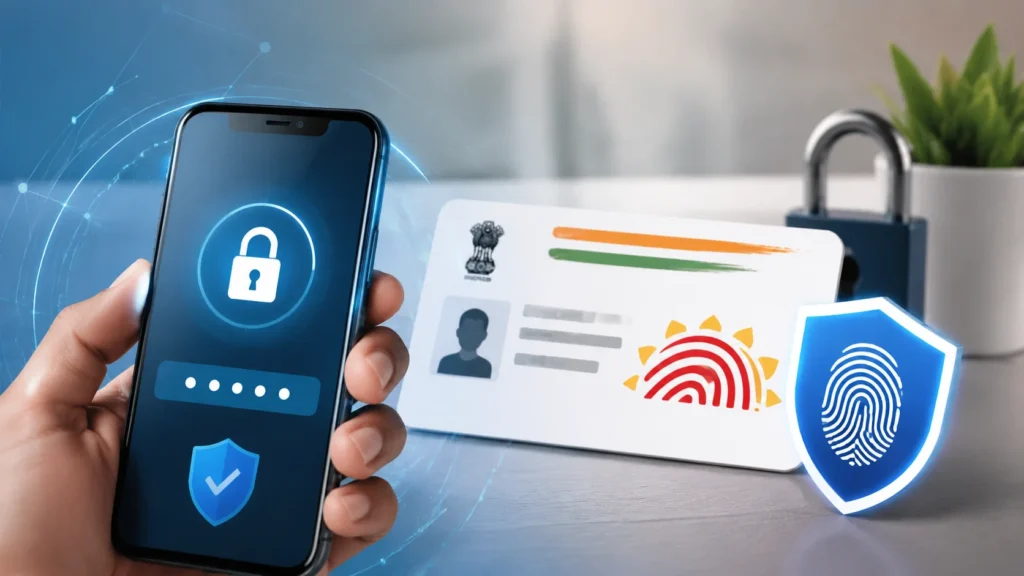
UIDAI also provides Aadhaar lock and unlock services. These services are connected to OTP and Virtual ID. UIDAI says that for locking Aadhaar, the Aadhaar number holder needs a 16-digit Virtual ID. If the person does not have a VID, it can be generated through SMS service or the UIDAI website. UIDAI’s FAQ explains that Aadhaar lock/unlock may involve OTP or TOTP during the process.
UIDAI’s SMS service also allows users to generate VID, retrieve VID, get OTP, lock Aadhaar, and unlock Aadhaar using SMS from the registered mobile number. This is important because locking Aadhaar can protect users from misuse. Once Aadhaar is locked, authentication using Aadhaar number may be restricted, while Virtual ID can still be used for authentication in supported cases. For regular users, the message is simple:
What About Biometric Lock and Unlock?
Biometric lock/unlock is another safety feature. UIDAI says that once biometric locking is enabled, the biometric remains locked until the Aadhaar holder temporarily unlocks it or disables the locking system. UIDAI also notes that the registered mobile number is essential to use this service, and if the mobile number is not registered, the Aadhaar holder needs to visit an enrolment centre or mobile update endpoint.
This is useful for people who do not regularly use biometric authentication. For example, if you rarely use fingerprint or iris authentication, you can keep biometrics locked. When you need to use them, you can unlock temporarily. This gives you more control. It also shows why OTP and mobile number still matter. Even advanced security features often depend on the registered mobile number for confirmation.
How Authentication History Helps Users
Aadhaar authentication history helps users see how their Aadhaar has been used for authentication. UIDAI’s FAQ says the authentication modality shows whether the transaction used demographic, biometric, face, or OTP authentication. This matters because users should know when their Aadhaar is being used. UIDAI also says Aadhaar number holders are notified on their registered email whenever UIDAI receives a biometric or OTP-based authentication request against their Aadhaar number.
This is a useful safety layer. If you see an authentication that you do not recognize, you should take it seriously. You can check your recent activity, lock biometrics if needed, update your contact details, and contact UIDAI through official channels. Aadhaar security is not only about OTP. It is also about visibility. Users should be able to know what happened, when it happened, and which authentication mode was used.
Does Aadhaar Authentication Prove Citizenship?
No. UIDAI clearly says that Aadhaar number or Aadhaar authentication does not, by itself, confer any right of citizenship or domicile. This is important because many people misunderstand Aadhaar. Aadhaar is an identity system. It helps verify identity for services, benefits, and authentication. But Aadhaar authentication alone is not proof of citizenship. This point should be included in any responsible article about Aadhaar authentication because it prevents confusion and misinformation.
How the 2026 UIDAI Update Helps Reduce Fraud
The 2026 changes can help reduce fraud in several ways. The Aadhaar App promotes consent control and selective sharing, which means users can share only the information needed instead of handing over full copies everywhere. UIDAI’s release says the app is privacy-first and supports data minimisation. Biometric lock/unlock helps users reduce the risk of biometric misuse. Authentication history helps users spot unusual activity.
Registered email notifications help users know when OTP or biometric authentication happens. Unique identifiers for government authentication transactions help departments audit and track scheme-wise activity more clearly. UIDAI’s Circular 1 of 2026 says using one code for many schemes can affect auditing, fraud detection, performance tracking, reliability, and transparency. Together, these changes make Aadhaar authentication more controlled. Fraud cannot be removed completely, but better systems reduce risk.
Safety Tips for Aadhaar OTP in 2026
This advice is simple, but it protects most users from common Aadhaar OTP scams.
What This Means for Banks, Telecom, Exams, and Government Services
Aadhaar authentication is used in many areas, including banks, telecom, exams, government benefits, welfare schemes, healthcare, education, insurance, taxation, and employment-related services. UIDAI’s update page says Aadhaar being used across government and non-government services makes it important that Aadhaar data is accurate and up to date.
What Has Not Changed in 2026?
Some things have not changed. OTP is still used. Registered mobile number is still important. UIDAI is still the Aadhaar authority. Aadhaar online services still require official platforms. Aadhaar authentication still does not prove citizenship. Users still need to protect OTP.
Users still need to be careful with unofficial websites. Biometric and OTP-based authentication still require user awareness. The main change is not that OTP disappeared. The main change is that Aadhaar authentication is becoming broader, safer, more app-based, and more traceable.
Why Many Users Are Confused About the “New OTP Policy”
Many users are confused because the phrase “new OTP policy” sounds like one simple rule. But Aadhaar authentication is not one rule. It is a system. The confusion also comes from different Aadhaar terms:
UIDAI. My Aadhaar. Aadhaar App. mAadhaar. OTP. TOTP. VID. Biometric lock. Aadhaar lock. Authentication history. Face authentication. QR verification. For a normal user, this can feel too much. That is why content about Aadhaar should be written in simple words. Users do not need heavy technical language. They need to know what to do, what to avoid, and which official service to use.
FAQs
Final Thoughts
The New OTP Policy Rolled Out by UIDAI 2026 should not be understood as OTP being removed.
OTP is still part of Aadhaar authentication. UIDAI continues to list OTP-based authentication as a valid mode. The real 2026 change is bigger. UIDAI is making Aadhaar authentication safer, more app-based, more consent-focused, and more traceable. For users, the most important step is to keep the Aadhaar-linked mobile number updated. Your registered mobile number is essential for many Aadhaar online services.
For safety, never share Aadhaar OTP with anyone. Use official UIDAI services only. Check authentication history if something feels wrong. Use biometric lock/unlock when needed. For government departments and service providers, UIDAI’s Circular 1 of 2026 makes transaction tracking clearer through unique identifiers. This helps auditing, fraud detection, transparency, and service reliability. So the simple answer is: UIDAI has not ended OTP. UIDAI has made Aadhaar authentication smarter.