Aadhaar Paperless Offline e‑KYC 2026: Safe & Convenient
Identity verification is a foundational requirement for accessing services such as banking, telecom, government welfare schemes, and financial onboarding. Traditionally, Aadhaar UIDAI KYC (Know Your Customer) verification was performed online through real‑time authentication or physical document submission. While effective, these approaches often raise concerns around connectivity, privacy, and data security.
To address these challenges, the Unique Identification Authority of India (UIDAI) has introduced Aadhaar Paperless Offline e‑KYC — a secure, private, and convenient solution that empowers individuals to verify their identity without internet access or exposing sensitive details.
This article provides overview of Aadhaar Paperless Offline e‑KYC, highlighting its features, benefits, generation process, real‑world applications, privacy considerations, and future scope.
What Is Aadhaar Paperless Offline eKYC?
Aadhaar Paperless Offline e‑KYC refers to a digitally signed document created by an Aadhaar number holder that allows offline identity verification without connecting to the Aadhaar database. This XML‑formatted document can be securely shared with service providers to authenticate the holder’s identity. It is also known as “Offline Aadhaar XML” or “Paperless Aadhaar,” reflecting its zero‑paper and digitally portable nature.
Unlike online e‑KYC, which requires real‑time access to the UIDAI servers and may involve biometric or OTP checks, offline e‑KYC works even without internet connectivity. This makes it especially useful in areas with limited infrastructure while reducing the dependency on continuous online authentication.
How Aadhaar Paperless Offline e‑KYC Works
The core idea behind offline e‑KYC is to empower individuals to generate a digitally signed file containing selected demographic and hashed contact information that can be verified offline by a service provider. Here’s how the mechanism functions:
This method ensures that critical identifiers like the full Aadhaar number are never exposed. Instead, a reference ID consisting of the last four digits of the Aadhaar number and a timestamp is included for verification and audit purposes.
Key Components of the Offline e‑KYC Document
The offline e‑KYC file includes the following essential elements:
Demographic Information
Details such as:
Hashed Contact Data
The document contains hashed versions of the registered:
Reference ID
This combines the last four digits of the Aadhaar number with a timestamp, ensuring the document’s freshness and preventing misuse.
Digital Signature
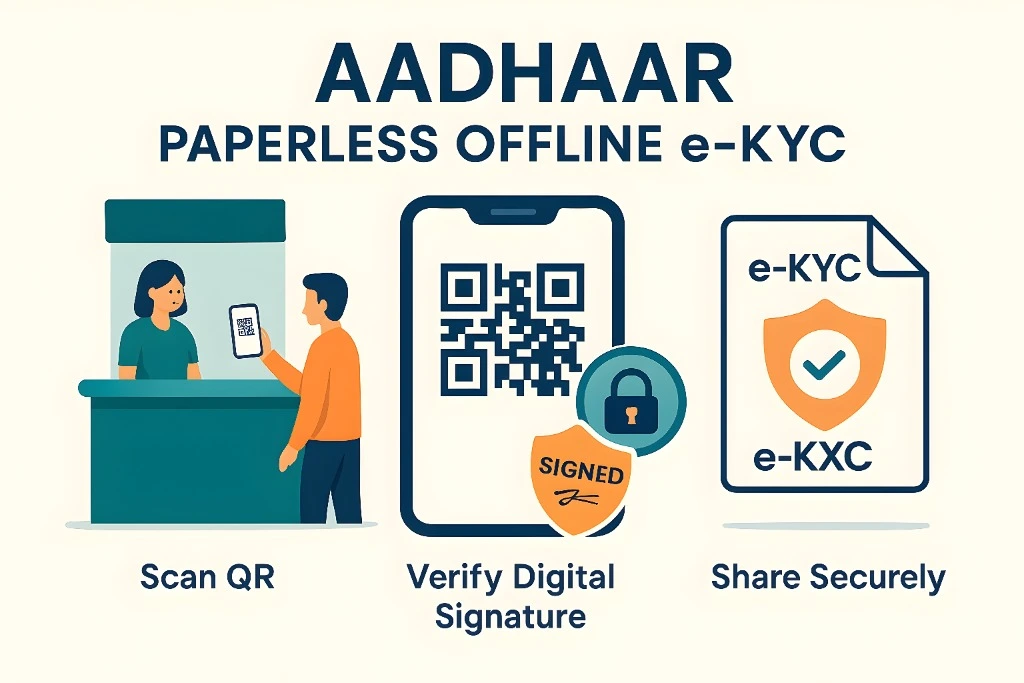
UIDAI digitally signs the XML file — an anti‑tamper mechanism that enables verifiers to ensure data integrity and authenticity without server calls.
Generating Aadhaar Paperless Offline e‑KYC: Step‑by‑Step Guide
Creating the offline e‑KYC is a straightforward process facilitated through UIDAI’s official web portal or mobile app. Follow these steps:
Step 1: Visit Official Portal
Go to the Aadhaar Paperless Offline e‑KYC section on the UIDAI website or open the mAadhaar app.
Step 2: Login
Enter your 12‑digit Aadhaar number or 16‑digit Virtual ID (VID) along with the captcha code. Click “Send OTP” and verify using the OTP received on the registered mobile number.
Step 3: Create Share Code
Set a secure share code (typically 4 digits). This acts as a password and must be shared with the verifier to decode the ZIP file.
Step 4: Download the ZIP File
Once authenticated, download the encrypted XML ZIP file. Store it safely on your device.
Step 5: Share with Verifier
Share the ZIP file and share code with the service provider for offline verification. You can also print it as a QR code for agencies that support QR scanning.
Benefits of Using Aadhaar Paperless Offline e‑KYC
This offline solution offers numerous advantages over traditional KYC processes:
1. Enhanced Privacy Protection
Unlike online KYC, the offline e‑KYC doesn’t expose your full Aadhaar number, biometric information, or other sensitive data. Only the selected demographic details and hashed contact information are shared.
2. No Internet Required for Verification
Once the XML file is received, service providers can verify it completely offline. This makes Aadhaar Paperless Offline e‑KYC extremely useful in regions with low connectivity.
3. User‑Controlled Consent
Individuals have full control over when and with whom they share their Aadhaar details. A share code mechanism further ensures that unauthorized access is not possible.
4. Eliminates Dependency on UIDAI Backend
Service providers do not need direct access to UIDAI’s live database for verification, reducing operational complexity and reliance on stable internet connectivity.
5. Prevents Tampering
The digital signature makes it easy to detect if the document has been tampered with or manipulated, strengthening security.
6. Voluntary Adoption
Users can choose whether or not to generate and share their Aadhaar offline e‑KYC document, making it a consent‑based system.
7. Versatility Across Use Cases
This solution is suitable for:
Offline e‑KYC vs Online e‑KYC: Key Differences
| Feature | Offline e‑KYC | Online e‑KYC |
| Data Sharing | Only selected data shared | Full data accessed through UIDAI |
| Internet Dependency | No | Yes |
| Authentication Timing | Pre‑generated | Real‑time |
| Privacy Risk | Lower | Higher |
| Technology Needed | None at verifier end | Requires technical infrastructure |
| Biometric Requirement | No | Sometimes yes |
Offline e‑KYC shines in privacy protection and accessibility, while online e‑KYC remains faster for real‑time verification when connectivity exists.
How Service Providers Verify Aadhaar Paperless Offline e‑KYC
Service providers use standard procedures to validate the offline e‑KYC document securely:
This process ensures accuracy and security without exposing Aadhaar numbers or requiring online authentication.
Security and Privacy Considerations
In comparison to traditional verification, Aadhaar Paperless Offline e‑KYC provides improved protection against misuse and unauthorized access. Key safeguards include:
Practical Use Cases
Aadhaar Paperless Offline e‑KYC is finding application in diverse scenarios:
Challenges and Limitations
While offline e‑KYC offers numerous benefits, there are also challenges:
Future Enhancements and Trends
UIDAI continues to focus on improving and expanding offline Aadhaar functionalities. Recent developments include:
📱 New Offline‑Enabled Aadhaar App
UIDAI announced an updated Aadhaar app that simplifies offline verification and enhances user security. Its features include encrypted data sharing and improved privacy tools.
🧭 Broader Adoption in Financial Systems
Efforts are underway to integrate offline Aadhaar e‑KYC into fintech and banking APIs to streamline the onboarding process for users and institutions alike.
FAQs
Final Thoughts
Aadhaar Paperless Offline e‑KYC represents a significant evolution in digital identity verification. It combines security, privacy, flexibility, and offline accessibility to create a robust alternative to traditional KYC processes. With a user‑controlled, encrypted document that can be validated without internet connectivity,
this system addresses many privacy and accessibility challenges inherent in real‑time online verification. As adoption grows across banking, telecom, government, and enterprise sectors, offline Aadhaar e‑KYC is set to become a cornerstone of secure identity verification in India’s digital ecosystem.