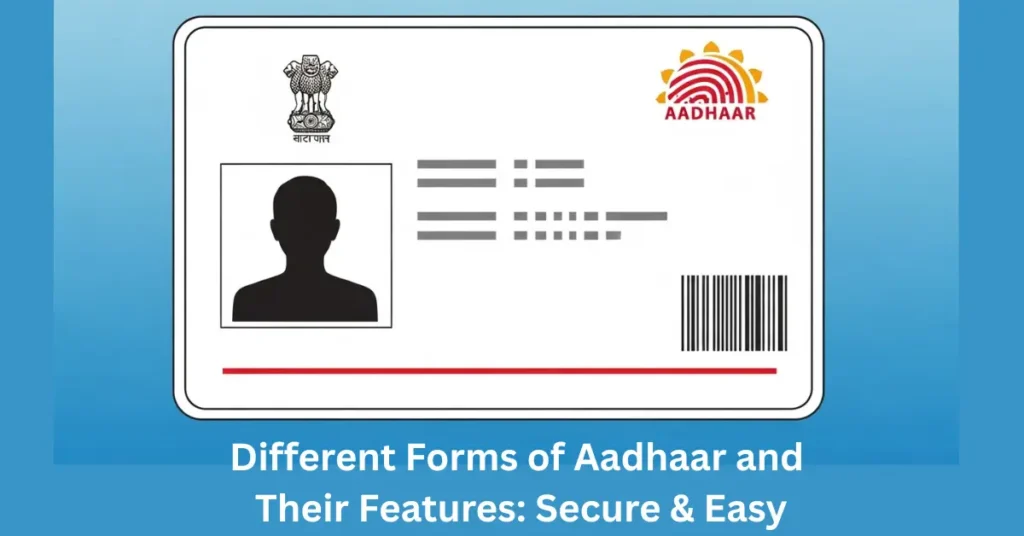
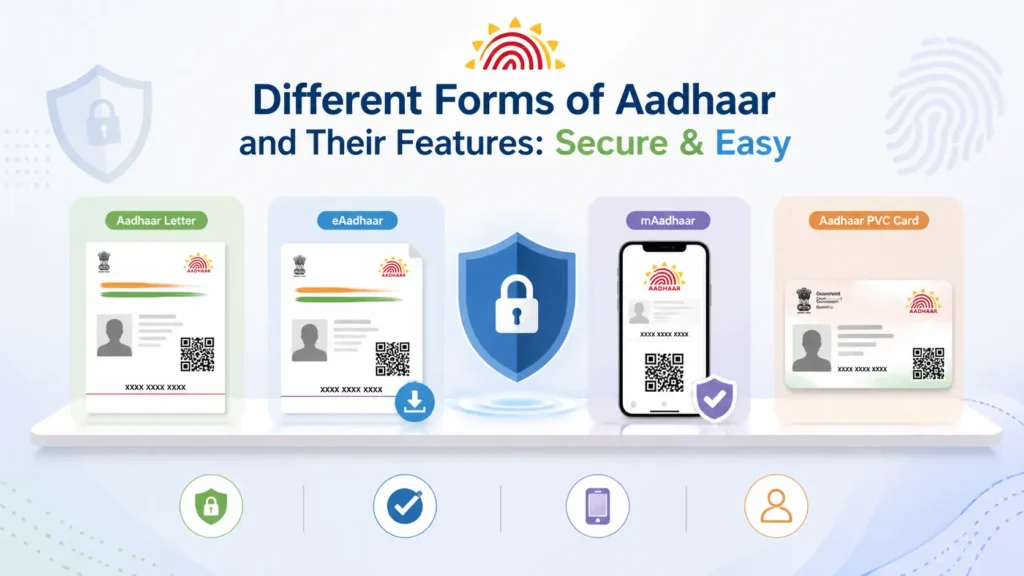
Different Forms of Aadhaar and Their Features: Secure & Easy
By
Aadhaar UIDAI, the 12-digit unique identification number issued by the Unique Identification Authority of India (UIDAI), has become an essential part of the Indian identity verification process. From government subsidies and financial transactions to mobile connections and banking, Aadhaar serves as a foundation for various services. Over the years, UIDAI has introduced various forms of Aadhaar to meet the growing demands of convenience, security, and accessibility.
In this article, we will explore each of the different forms of Aadhaar in-depth, focusing on their features, security, accessibility, and the pros and cons of each. Whether you’re looking for a physical document, a digital option, or a mobile solution, this guide will help you decide which form best suits your needs.
1. Aadhaar Letter: The Physical Identity Document
The Aadhaar Letter is the original form of Aadhaar that is delivered to residents through postal mail. This physical document serves as the most basic and traditional form of identification. For many residents, this is the starting point of their Aadhaar journey.
Key Features:
Material and Durability: The Aadhaar Letter is printed on secure, tear-proof paper to ensure its durability.
Personal Details: It contains critical information such as the individual’s Aadhaar number, full name, gender, date of birth, and residential address.
QR Code: The letter includes a digitally signed QR code, which holds encrypted demographic details along with the individual’s photograph.
Offline Use: One of the key advantages of the Aadhaar Letter is that it can be used for offline identity verification. Since it doesn’t require biometric authentication, it serves as a reliable identity proof in rural areas or places with limited internet connectivity.
Free of Charge: The Aadhaar Letter is provided free of charge during the initial Aadhaar enrollment or any mandatory biometric updates.
Usage in Various Scenarios:
Government Services: The Aadhaar Letter is widely used for enrollment in government schemes, LPG connections, and more.
Banking: It is used in banks for Know Your Customer (KYC) processes and to open bank accounts.
Travel: The letter can be used for booking tickets for domestic travel, such as train or air travel.
2. eAadhaar: The Digital Aadhaar Version
As the world increasingly shifts towards digitalization, eAadhaar has emerged as a popular choice for those seeking an easily accessible, online version of Aadhaar. Available as a downloadable PDF from the UIDAI website, eAadhaar provides the same benefits as the physical Aadhaar letter but with added convenience and security.
Key Features:
Password Protection: eAadhaar is password-protected to ensure that only the rightful owner can access it. The password is typically the first four letters of your name (in uppercase) followed by your year of birth.
Masked Aadhaar: The Masked Aadhaar version provides an extra layer of privacy by displaying only the last four digits of the Aadhaar number. This option is ideal for users who wish to share their Aadhaar details without exposing the entire number.
Digital Verification: Just like the Aadhaar Letter, eAadhaar includes a digitally signed QR code, which can be used for both online and offline verification.
Accessibility: eAadhaar is available for download at any time through the UIDAI website, making it a convenient option for residents who need their Aadhaar information on the go.
No Cost: eAadhaar can be downloaded at no cost, and it’s automatically updated every time a resident updates their Aadhaar information.
Usage in Various Scenarios:
Online KYC: eAadhaar is commonly used for online KYC (Know Your Customer) processes in banking and other financial services.
Government Subsidies: Many government schemes, like direct benefit transfers (DBT), allow the use of eAadhaar for identity verification.
Authentication: Users can utilize eAadhaar for authenticating transactions with various government portals and services.
3. mAadhaar: Aadhaar in Your Pocket
For those who prefer a mobile-first approach, mAadhaar offers a handy solution. This mobile application, available for both Android and iOS, allows residents to carry their Aadhaar details with them on their smartphones.
Key Features:
Offline Sharing: mAadhaar allows users to share their Aadhaar details through a QR code, even when offline. This makes it particularly useful in areas with limited internet connectivity.
Biometric Lock/Unlock: The app lets users lock or unlock their biometric authentication settings, ensuring that their biometric data is secure when not in use.
Secure Data Storage: Aadhaar information is securely stored on the device after authentication, and the data is not stored on any remote server, offering added privacy.
Automatic Updates: mAadhaar is automatically updated whenever there is an update to the resident’s Aadhaar details, making it a real-time solution.
Convenient Access: With just a tap, users can access their Aadhaar information anytime, making it a more convenient option for residents on the go.
Usage in Various Scenarios:
Selective Sharing: The app enables selective sharing of Aadhaar details with authorized entities by generating a unique QR code that contains only the required information.
Identity Verification: mAadhaar is accepted in government offices, banks, and other service providers for identity verification.
4. Aadhaar PVC Card: A Durable and Secure Option
The Aadhaar PVC Card was introduced in 2021 as a modern, durable alternative to the paper Aadhaar Letter. It has quickly become popular due to its sturdiness and advanced security features.
Key Features:
Durability: Made of PVC (polyvinyl chloride), the card is highly durable, akin to ATM or debit cards. It is resistant to wear and tear, making it ideal for everyday use.
Holograms and Security Features: The PVC card comes with multiple security features such as holograms, micro text, ghost images, and a guilloche pattern to prevent tampering.
Convenience: The card is compact and fits easily into a wallet, making it highly portable.
QR Code and Photograph: Just like the Aadhaar Letter, the PVC card contains a QR code with demographic details and a photograph for offline verification.
Online Ordering: Residents can order the Aadhaar PVC Card online for a nominal fee of ₹75, and it is delivered via speed post.
Usage in Various Scenarios:
Banking: The PVC card can be used for KYC purposes in banks and financial institutions.
Offline Verification: The card can be presented for offline identity verification at government offices, schools, and other public service centers.
A Comparison of Different Forms of Aadhaar
To provide further clarity, let’s compare the features of the different Aadhaar forms available:
Feature
Aadhaar Letter
eAadhaar
mAadhaar
PVC Card
Format
Physical Paper
Digital PDF
Mobile App
Physical Card
Cost
Free
Free
Free
₹75
Durability
Moderate
N/A
N/A
High
Offline Use
Yes
Yes
Yes
Yes
QR Code
Yes
Yes
Yes
Yes
Photo in QR
No
Yes
Yes
Yes
Security Features
Basic
Digital
Digital
Advanced
Accessibility
Posted
Downloadable
Mobile App
Posted
Updates
New issue required
Auto-updated
Auto-updated
New order required
Which Aadhaar Form is Right for You?
Choosing the right form of Aadhaar depends on your needs and preferences. Let’s summarize the key advantages of each form to help you decide:
Aadhaar Letter: Ideal for those who prefer a physical identity document for offline verification.
eAadhaar: Best suited for digital-savvy users who want quick access to their Aadhaar information for online verification and transactions.
mAadhaar: The perfect choice for users who need Aadhaar details on the go and value mobile-first solutions.
Aadhaar PVC Card: Recommended for individuals seeking a durable, portable, and tamper-proof form of Aadhaar with enhanced security.
Each Aadhaar form serves its purpose, whether you’re looking for a traditional paper form, a convenient digital version, or a mobile solution. The introduction of the PVC card has added an extra layer of convenience and security, making Aadhaar even more accessible and reliable for millions of residents across India.
Future of Aadhaar and Its Forms
The evolution of Aadhaar forms is a testament to the growing importance of digital and mobile-based identity verification in India. With UIDAI’s commitment to improving accessibility, security, and usability, the future of Aadhaar is likely to include even more advanced features, such as:
Integration with more government services: Aadhaar’s role in government schemes and services is expected to expand further.
Enhanced security protocols: With increasing security concerns, Aadhaar forms may include additional layers of encryption and multi-factor authentication to safeguard user data.
Global recognition: As India’s digital infrastructure continues to evolve, Aadhaar may serve as a model for other countries looking to implement similar identity systems.
Aadhaar is available in multiple forms: Aadhaar Letter, eAadhaar, mAadhaar, and Aadhaar PVC Card, each catering to different needs like physical documents, digital access, and mobile convenience.
You can download your eAadhaar from the UIDAI official website in PDF format. It is password-protected for security and can be downloaded free of charge at any time.
Yes, the Aadhaar PVC Card is designed with advanced security features like holograms, micro-text, and a guilloche pattern, ensuring it is tamper-proof and highly secure.
You can order the Aadhaar PVC Card online for ₹75 from the UIDAI website. It will be dispatched via speed post after your order is processed.
The Aadhaar Letter is a physical document mailed to you, while eAadhaar is a downloadable digital version in PDF format. Both are equally valid for identity verification.
Yes, mAadhaar allows offline sharing of Aadhaar details through a QR code, making it a convenient option even without an internet connection.
eAadhaar includes a digitally signed QR code and is password-protected to ensure the security of your Aadhaar information during download and sharing.
You can lock/unlock biometric authentication directly within the mAadhaar app, offering added control over your biometric data.
Yes, Aadhaar is widely accepted for Know Your Customer (KYC) purposes in banks and financial institutions, allowing seamless account opening and other services.
Yes, all forms of Aadhaar—the Letter, eAadhaar, mAadhaar, and PVC Card—are equally valid and secure for identity verification and other official uses.
Final Thoughts
Aadhaar has become a cornerstone of identity verification in India, offering flexible and secure options through its various forms—Aadhaar Letter, eAadhaar, mAadhaar, and Aadhaar PVC Card. Each form serves different needs, from the traditional paper version to mobile-friendly solutions and durable card options.
As Aadhaar continues to grow, its role in facilitating seamless access to government services and financial systems will only expand. However, it is important for users to prioritize security and use Aadhaar responsibly, especially in the digital space. Looking ahead, Aadhaar will remain a crucial tool in shaping India’s digital future, providing residents with secure, convenient identity solutions.
Getting an “Invalid Session” error every time you login to the My Aadhaar Portal can be frustrating, especially when you need to download Aadhaar, update documents, check status, order PVC card, or use another Aadhaar service urgently. The good news is simple: in most cases, this error does not mean your Aadhaar is blocked. It…
In today’s digital age, where personal information is increasingly vulnerable, protecting our identity has become a significant concern. The Unique Identification Authority of India (UIDAI) has introduced several innovative solutions to address these concerns, one of the most important being the Aadhaar UIDAI Virtual ID (VID). This article provides a complete and detailed guide to…
Many people recently started seeing posts and news reports about a new Aadhaar card design in 2026. The claim was that Aadhaar may soon show only a photo and QR code, while details like name, Aadhaar number, date of birth, gender, and address may no longer be printed on the card. This created confusion among…
Aadhaar has become an indispensable identity system in India, managed by Aadhaar UIDAI, linking millions of citizens with essential services such as banking, government schemes, taxation, and mobile authentication. Because of its widespread use and critical importance, having access to the Aadhaar Customer Care Number and other support services is essential for clear, accessible, and…
The Aadhaar UIDAI is responsible for managing the Aadhaar system, the world’s largest biometric identity program. As a critical tool for public service delivery and identity verification in India, Aadhaar contains essential demographic and biometric data of over a billion Indian citizens. Given the sensitive nature of this information, protecting individual privacy and data security…
In a world where identity verification and digital authentication have become integral to daily life, Aadhaar UIDAI stands at the core of India’s digital identity ecosystem. Offered by the Unique Identification Authority of India (UIDAI), Aadhaar is a 12‑digit unique identification number that securely links your demographic and biometric information. Over the years, Aadhaar has…