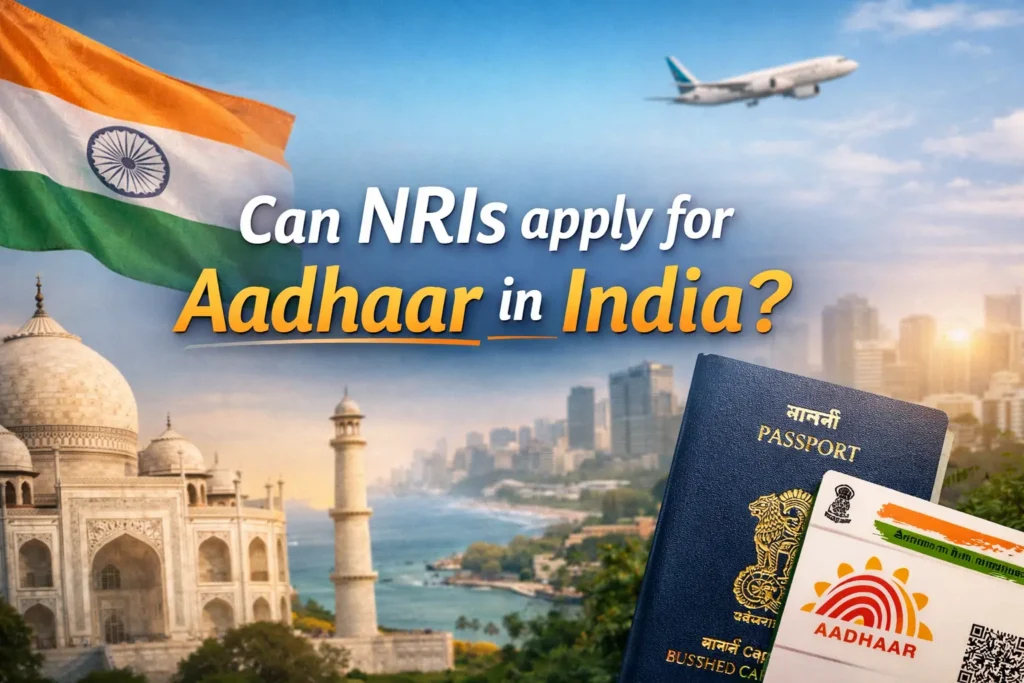
Can NRIs apply for Aadhaar in India? Quick Guide 2026

Aadhaar—the 12-digit unique identity number issued by the Aadhaar UIDAI—is one of the most widely accepted proofs of identity and address in India. While it is mandatory for residents for a host of services like banking, tax filing, subsidies, and mobile connections, many Non-Resident Indians (NRIs) are unsure whether they can obtain Aadhaar and how NRIs apply for Aadhaar in India, along with the eligibility requirements and process involved.

This comprehensive guide answers that question and goes far beyond, explaining eligibility, required documents, enrolment steps, options for minors, usage limitations, benefits, common misconceptions, and more—based on the latest official rules and practical insights.
Can NRIs apply for Aadhaar in India? Quick Guide 2026

Understanding Aadhaar and Its Purpose

Aadhaar is not just a paper or plastic card—it’s a digital identity linked to biometric (fingerprints and iris) and demographic data. Issued by UIDAI, it serves as a trusted proof of identity and address that is accepted by government bodies, banks, telecom companies, and service providers throughout India.

For NRIs, having an Aadhaar can simplify many formalities during visits to India, including banking procedures, property transactions, and financial compliance.

Can NRIs Apply for Aadhaar in India?

Yes. Non‑Resident Indians can apply for Aadhaar. Provided certain conditions are met. The core eligibility is centered around two key factors:

1. Valid Indian Passport

NRIs holding a valid Indian passport can apply for Aadhaar. This passport acts as mandatory Proof of Identity (PoI) and often Proof of Address (PoA) during enrolment.

2. Physical Presence in India

NRIs must be physically present in India to complete the Aadhaar application process, especially for biometric capture (fingerprints, iris scan, photograph). Online applications from overseas are not permitted.

3. Residential Condition (Clarified Rules)

Under earlier rules, an individual needed to stay in India for at least 182 days in the 12 months before applying. However, this requirement has been relaxed for NRIs with valid Indian passports, allowing them to apply on arrival in India without completing 182 days. This is an important distinction:

  • NRIs with Indian passports can apply immediately.
  • NRIs without Indian passports, OR OCI/foreign nationals, may still need the 182‑day condition in some cases.

Who Is Considered an NRI?

In Indian legal terms, an NRI is a person of Indian nationality who resides outside India for employment, business, or any other purpose, indicating an intention to stay abroad for an uncertain period. Such individuals retain Indian citizenship but satisfy the “non‑resident” tax status defined by the Income Tax Act.

Eligibility Breakdown for NRIs

Below is a detailed look at eligibility based on documentation and status:

NRIs with Valid Indian Passport

  • Eligible immediately upon arrival in India.
  • Passport is accepted as both PoI and PoA (if address is Indian).

NRIs Without Indian Passports

  • If holding only a foreign passport, eligibility may depend on meeting the 182‑day stay requirement in India before application.

Overseas Citizen of India (OCI) Cardholders

  • OCI holders are not automatically eligible; they must satisfy the 182‑day stay rule and have proof of an Indian address to enroll.

Foreign Nationals & Other Categories

  • Certain categories other than NRIs (like long‑term visa holders) may apply if they meet stay and documentation conditions, but these are handled differently.
Can NRIs apply for Aadhaar in India? Quick Guide 2026

Why NRIs May Want an Aadhaar Card

Although Aadhaar is optional for NRIs (it is not legally mandatory unless specified), it offers significant practical advantages:

  • Identity Proof Simplification: Aadhaar is widely accepted across government and private institutions as trusted identification.
  • Banking & Financial Transactions:Many banks and financial services prefer Aadhaar for KYC verification and smoother account operations.
  • Income Tax Filing:Aadhaar helps in e‑filing income tax and linking with PAN (Permanent Account Number) if tax obligations arise due to Indian income.
  • Real Estate and Property:Aadhaar simplifies documentation for property purchases, mortgage processing, and legal verification.
  • Government Scheme Access:Some government services and benefits use Aadhaar as a basis for authentication and subsidy distribution.

Documents Required to Apply

Here’s a clear checklist of documents needed when applying for Aadhaar as an NRI:

  • Mandatory: Valid Indian Passport – serves as Proof of Identity and often Proof of Address.

Additional (Depending on Case)

  • Secondary Proof of Address if passport doesn’t hold the Indian address.
  • Proof of Date of Birth (if not available in passport).
  • Proof of Relationship (for minors).

Notes

  • Birth certificate is now mandatory for those born on or after 1 October 2023.
  • NRIs must carry originals for verification at the enrolment centre.

Step‑by‑Step Application Process

  • Choose an Aadhaar Enrolment Centre: Visit any Aadhaar Seva Kendra or enrolment centre across India. Slots can be booked via the UIDAI website.
  • Fill Enrolment Form: Complete the Aadhaar enrolment form. Indicate your NRI status — this helps the operator process your application correctly.
  • Submit Documents: Hand in the valid passport and other supporting documents for verification.
  • Biometric Capture: As part of the application process, NRIs must provide biometric data, including fingerprints and an iris scan. These biometric details are mandatory for generating the Aadhaar ID, which remains functional just like Aadhaar for residents.
  • Acknowledgement Slip: You will receive a slip with an enrolment number. Keep it safe – it’s needed to track your Aadhaar status.
  • Wait for Aadhaar Generation: UIDAI typically issues Aadhaar within 60–90 days from enrolment. Once ready, you can download e‑Aadhaar online.

Aadhaar for NRI Children

NRIs can enroll their children for Aadhaar with a valid Indian passport for the child:

  • Below 5 Years: Only a photograph is taken initially; biometrics are updated at 5 and again at 15 years.
  • Ages 5 – 18: Biometrics collected along with parental consent.

Updating Aadhaar Details

NRIs should ensure their Aadhaar data remains accurate. Address, passport number changes, and contact details can be updated online or at an Aadhaar centre.

Common Myths vs. Facts About Aadhaar for NRIs

MythReality
Aadhaar is mandatory for all NRIs.It’s optional unless specific services demand it.
You can apply for Aadhaar from abroad.You must be physically present in India.
NRIs must stay 182 days before applying.This rule no longer applies if you have an Indian passport.
Aadhaar is required for NRI PAN.Not mandatory unless resident criteria are met; exceptions apply.

Limitations & Important Considerations

  • Aadhaar Is Not Citizenship Proof: Aadhaar establishes identity but does not grant voting rights, citizenship benefits, or residency status.
  • Not Required for Some Financial Transactions: NRIs can often use passports and PAN for KYC and banking. Aadhaar simplifies processes but is not the only accepted document.
  • Some Services May Still Require Additional Criteria: Services like government subsidies, specific financial instruments, or tax status may require separate eligibility or documentation.
  • Checking Your Aadhaar Status: Once you have your enrolment number, you can check your Aadhaar application status online via the UIDAI portal and download the e‑Aadhaar once issued.

Final Tips Before You Apply

  • Bring all original documents and photocopies.
  • Ensure your Indian address is correct on the form.
  • Carry contact info that works while in India (email/mobile).
  • Track your Aadhaar status using the UIDAI website.
  • Contact UIDAI or Aadhaar Seva Kendra for any updates or questions.

FAQs

Yes, Non-Resident Indians (NRIs) can apply for Aadhaar, provided they have a valid Indian passport. They must also be physically present in India to complete the biometric process at an Aadhaar enrolment centre.

No, unlike Indian residents, NRIs are exempt from the 182-day stay requirement. As long as they have a valid Indian passport, they can apply for Aadhaar on arrival in India.

NRIs need to provide a valid Indian passport as the primary document. Additional documents may be required for address proof if the passport does not include an Indian address.

If an NRI does not have an Indian passport, they may not be eligible to apply for Aadhaar unless they fulfill the 182-day stay requirement or meet specific residency conditions. OCI and foreign passport holders are subject to different rules.

No, NRIs do not need to prove their duration of stay in India to apply for Aadhaar, as the 182-day stay requirement is waived for them.

Yes, NRIs can apply for Aadhaar for their minor children with a valid Indian passport. For children under 5 years, only a photograph is captured initially, and biometric data is updated when the child reaches the age of 5 and 15 years.

After submitting the application and biometric data, NRIs typically receive their Aadhaar within 60–90 days. They can track the status using their enrolment number.

Yes, NRIs should keep their Aadhaar details updated, especially if there are changes in their passport or address information. This can be done online or at an Aadhaar Seva Kendra.

Yes, NRIs must provide biometric data (fingerprints, iris scan, and photograph) during the Aadhaar application process, just like Indian residents.

Yes, NRIs can use their Aadhaar card for various government services during their visits to India, such as banking, mobile connections, and availing subsidies. However, some services may still require resident status.

Final Thoughts

Yes—NRIs can apply for Aadhaar, and there are compelling reasons to do so if you frequently travel to India, hold assets there, or engage with financial systems linked to Indian identity verification. However, it is not legally compulsory for all NRIs unless a particular institution or government process mandates it. The flexibility introduced in recent years (especially the removal of the waiting period for those with Indian passports) makes enrolment easier and more practical than ever.
Similar Posts

Leave a Reply

Your email address will not be published. Required fields are marked *