Aadhaar Enrollment for Elderly Born Before 1970: Easy Guide
Aadhaar Enrollment for Elderly Born Before 1970 — India’s unique 12‑digit identity number issued by Aadhaar UIDAI serves as the foundation for accessing numerous government benefits, banking services, subsidy schemes, and more. The Unique Identification Authority of India (UIDAI) reports that over 138 crore residents now hold Aadhaar, and enrollment remains free of cost.
However, individuals born before 1970 — particularly the elderly — often face challenges due to lack of birth certificates or school records. This guide explains practical and official methods for Aadhaar Enrollment for Elderly Born Before 1970, including the use of alternative documents, Head of Family (HoF) enrollment, introducers, and UIDAI‑approved procedures.
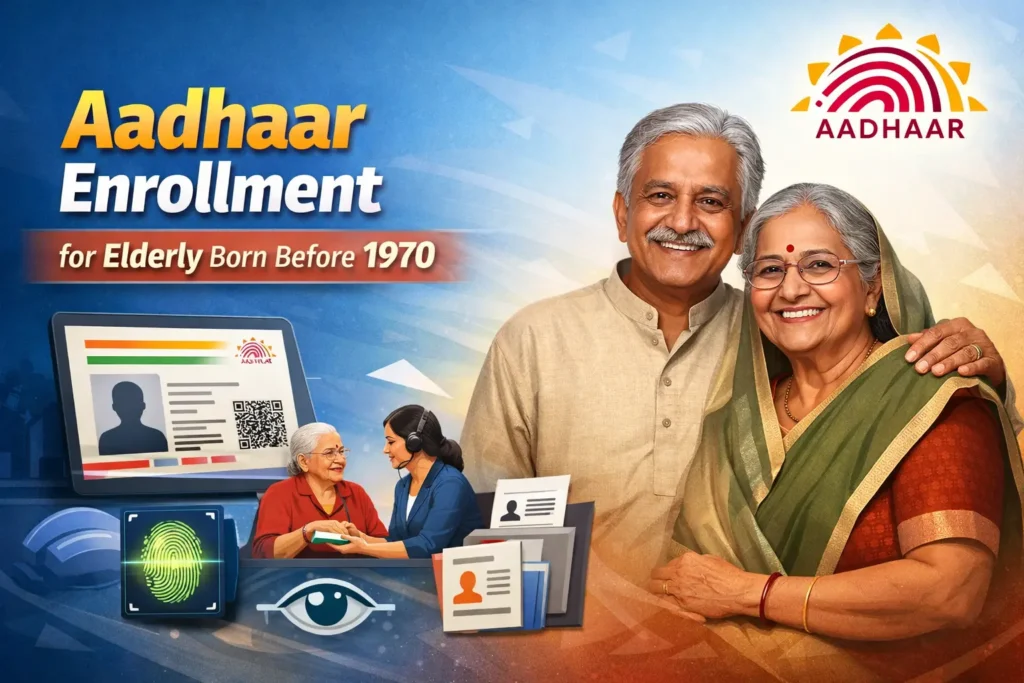
Why Older Individuals Struggle With Aadhaar Enrollment
Many senior citizens in India, particularly those eligible for Aadhaar Enrollment for Elderly Born Before 1970, were born at home and may not have had their births officially registered. School certificates — typically used as age proof — may also be missing. Since Aadhaar enrollment usually requires Proof of Identity (PoI), Proof of Address (PoA), and Proof of Date of Birth (PDB), lack of these documents complicates the process. But UIDAI provides flexibility through alternative documentary support and special modes of enrollment for such cases.
Understanding Aadhaar Document Requirements (Official)
For any Aadhaar application, a combination of the following documents is expected:
Even if none of these are available, UIDAI supports additional methods like HoF and Introducer enrollment and recording declared or approximate date of birth.
What If Birth Certificate Is Unavailable?
For those born before birth registration became mandatory (before 1 April 1970), the following options often work:
1. Non‑Availability of Birth Certificate (NABC)
An NABC is a formal certificate issued by local authorities like the Municipal Corporation (MC) or Sub‑Divisional Magistrate (SDM) stating that no birth record exists. It can pave the way for other proofs to be accepted during Aadhaar enrollment.
2. Accepted Alternative Documents
If an official birth certificate cannot be produced, you may use any of these:
Such alternatives are widely accepted by enrolment centers when validated with supporting context.
3. Declared or Approximate Date of Birth
If no DOB document exists, UIDAI allows applicants to state an approximate or “declared” birth year during enrollment, which is then recorded in the Aadhaar database. This makes enrollment possible without formal age proof.
Note: Aadhaar itself is not considered a legal DOB proof for other government or legal requirements — it’s meant primarily as identity proof. Recent policy clarifications from UIDAI emphasize this distinction.
Special Enrollment Methods for the Elderly
Head of Family (HoF) Based Enrollment
If a senior lacks PoI and PoA documents, they can apply through a Head of Family who has valid proofs. The HoF enrolls first, and then other family members (including elderly applicants) are introduced during the same session.
This method allows residents without standard identity or address proofs to secure Aadhaar.
Enrollment Through an Introducer
When someone has no documents whatsoever (no PoI, PoA, or PDB), UIDAI permits enrollment with the help of a registered introducer — a person appointed by UIDAI’s Registrar to authenticate the applicant’s details.
Important points about introducer enrollment:
This process ensures that even people without documents can obtain Aadhaar.
Official Aadhaar Enrollment Process (Step‑by‑Step)
Here’s how elderly individuals (and others) can complete enrollment:
- Locate Nearest Aadhaar Enrollment Center – Use the UIDAI website to check locations.
- Fill the Enrollment Form – Provide accurate details and supporting proofs if available.
- Document Verification – Originals must be presented; the operator verifies them.
- Biometric Capture – Fingerprints, iris scan, and photograph are taken.
- Acknowledgment Slip – You receive this with a temporary Enrolment ID to track progress.
Enrollment is free, and the Aadhaar number is generally issued within a few weeks.
Key Tips to Make the Process Smooth
FAQs
Final Thoughts
While obtaining Aadhaar without conventional birth or school documents can be challenging, UIDAI’s flexible options such as HoF enrollment, introducer support, and alternative proofs make it achievable for elderly individuals born before 1970. By following official procedures and using UIDAI‑recognized documents, senior citizens can secure their Aadhaar and access essential services without unnecessary hurdles.