Complete Guide: mAadhaar App Biometric data Safety 2026
If your phone is hacked, the mAadhaar app is not supposed to expose your raw fingerprint, iris, or face data as normal stored phone data. According to Aadhaar UIDAI guidelines on mAadhaar App biometric data safety, biometric data used for Aadhaar verification is encrypted right away and is not allowed to be stored by mobile phone companies or requesting entities. That is the most important point to understand.
But that does not mean the situation is completely safe. If a hacker gets access to your phone, your app, messages, profile information, or security settings could be seen or misused. That is why the real danger is often linked to phone control, OTP misuse, or unauthorized access rather than direct theft of your raw biometric file from the app. This is also why UIDAI provides safety tools such as biometric lock and Aadhaar lock.
What biometric data means here
Biometric data is usually understood as fingerprint, iris, and face related data used for Aadhaar authentication. Many people imagine that this full data is saved inside the app and can be pulled out if the phone is hacked. That fear is understandable, but official guidance points to a more protected design.
UIDAI says that when biometrics are used for Aadhaar verification, they are encrypted immediately. It is also stated that mobile phone companies are not allowed to store or use those biometrics. Because of that, the image many people have in mind, where a hacker opens the phone and finds a saved fingerprint file inside the app, is not how the system is intended to work.
This does not mean zero risk exists. It only means the risk should be understood correctly. It is more useful to worry about access misuse than to assume your full biometric record is sitting openly inside your phone.
What can actually happen if the phone is hacked
When a phone is hacked, control over many parts of the device can be gained. Messages can be read. OTP codes can be intercepted. Saved details may be viewed. App access can be abused if the device is already unlocked or if security is weak. In that case, the attacker may not need your raw biometric file to cause trouble. Understanding mAadhaar App biometric data safety helps users know that their raw biometric data is generally protected even if the device is compromised.
For example, if access to your registered mobile number is gained, account-related actions may be attempted. If your app is open or your device has weak screen security, profile details inside the app may be seen. If authentication history is visible, personal use patterns may also be learned. In short, privacy harm can still happen even without direct access to raw biometric records. Older public reporting on mAadhaar weaknesses also points to the importance of mAadhaar App biometric data safety, highlighting that app-level and device-level weaknesses can still create real danger.
Is the mAadhaar app unsafe then
That would be too simple a conclusion. A better answer is this. The app is designed with security features, but your phone security matters just as much. Understanding mAadhaar App biometric data safety shows why the app’s protections are strong, yet device security remains equally important.
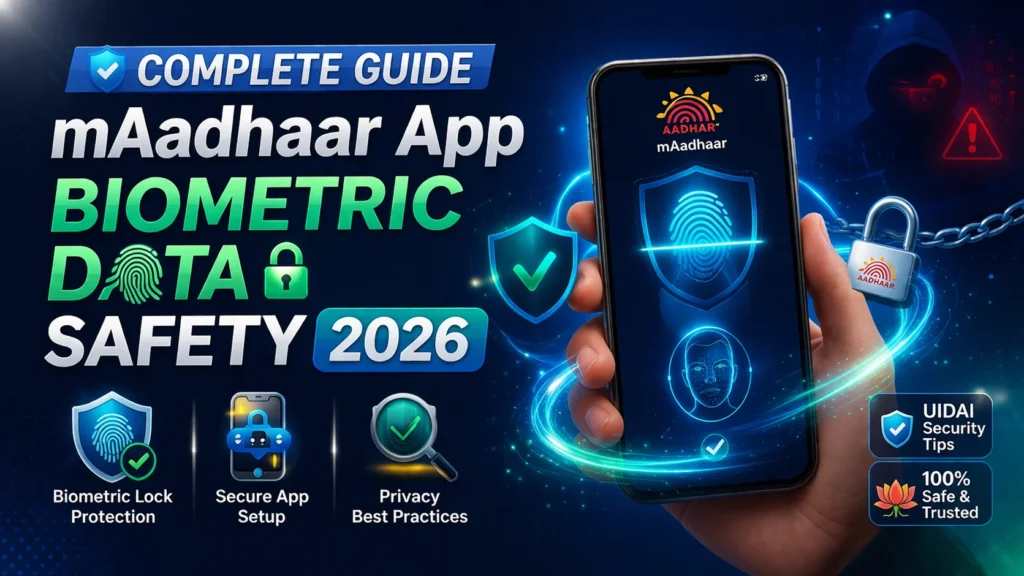
UIDAI offers important user controls through its system. Biometric lock is provided so biometric authentication can be blocked until the user unlocks it again. Aadhaar lock is also offered to add another layer of safety. Authentication history can be checked as well. These features show that privacy and misuse prevention were considered in the system design.
At the same time, no app can fully protect a person if the device itself is under attacker control. If malware is present, if a fake app is installed, if the screen lock is weak, or if OTP access is taken, then risk goes up fast. So the mAadhaar app should not be called unsafe by default. But it should not be treated as magic protection either.
What UIDAI says about biometric lock
One of the most useful protections is biometric lock. UIDAI says fingerprint, iris, and face biometrics can be locked. Once that is done, biometric-based Aadhaar authentication cannot be used until the user unlocks it. This demonstrates how mAadhaar App biometric data safety is built into the system to prevent unauthorized use of biometrics.
This feature matters a lot for people who are worried about misuse. If a phone compromise is suspected, biometric lock can reduce risk quickly. It highlights another layer of mAadhaar App biometric data safety by blocking one major path of abuse, even though it will not clean malware from the phone.
What Aadhaar lock does
Aadhaar lock is another useful control. UIDAI explains that Aadhaar lock adds security for the Aadhaar holder. When Aadhaar is locked, use of UID, UID token, and VID based authentication is blocked until it is unlocked again. This can be helpful if you feel your details may be misused.
This feature is important because many people only think about biometrics. But misuse can happen through more than one path. That is why locking both biometrics and Aadhaar can be a smart response when something feels wrong.
Why users should check authentication history
If misuse is suspected, proof should be checked before panic grows. That is where authentication history becomes useful. The mAadhaar service allows users to see past authentication activity, which is an important part of mAadhaar App biometric data safety. Recent explainers based on UIDAI features note that history for up to six months can be checked. Unknown entries can help a user spot whether something unusual happened, further supporting mAadhaar App biometric data safety by enabling timely action.
This step is often missed. Many people get scared, but no check is made. A calm review of history is better. If entries look strange, action can be taken faster. Locks can be enabled. Support can be contacted. Device cleanup can be started.
Does a hacked phone mean Aadhaar identity theft is certain
No. A hacked phone raises risk, but identity theft is not guaranteed. Several things would still affect what an attacker can actually do. App access may be needed. OTP control may be needed. Your device lock may need to be bypassed. In some cases, biometric or Aadhaar lock may already stop misuse, which is why understanding mAadhaar App biometric data safety matters. So the situation should be treated seriously, but fear should not be allowed to turn into confusion.
The right mindset is practical. Risk should be reduced step by step. Locks should be used. Authentication history should be checked, emphasizing mAadhaar App biometric data safety. Device security should be restored. Passwords should be changed where needed. The problem should be handled with calm action, not panic.
What should be done if the phone is hacked
The first step should be to secure the phone. A trusted person or repair expert may be needed if the device is badly compromised. The next step should be to lock what can be locked. Biometric lock should be enabled if not already active. Aadhaar lock should also be considered if misuse is feared. Authentication history should be checked for unknown activity. If the registered mobile number is also at risk, that problem should be handled quickly because OTP based misuse becomes much easier when number control is lost.
After that, app security should be reviewed. Only the official app should be kept. Untrusted downloads should be removed. Screen lock strength should be improved. System updates should be installed. In many cases, the safest choice is to clean the phone fully and sign in again only after the device is trusted.
A direct truth that helps
The biggest confusion comes from one wrong idea. Many users think the app itself stores full raw biometric files in a simple form, ready to be stolen if the phone is hacked. Current UIDAI guidance does not support that fear. Biometrics used for verification are described as encrypted immediately and not allowed to be stored by phone companies or requesting entities.
But a second truth must also be kept in mind. A hacked phone is still dangerous. Not because it easily gives out raw biometric records in the normal way people imagine, but because it can expose other useful data and access paths. That is why both parts of the story matter. The official system design offers strong protection for biometric handling, yet weak device security can still create serious trouble.
FAQs
Final Thoughts
So, does the mAadhaar app expose biometric data if your phone is hacked, In most normal cases, raw biometric data is not supposed to be exposed from the app as ordinary local phone data. UIDAI says biometrics used in verification are encrypted immediately and are not allowed to be stored by mobile phone companies or requesting entities.
Still, real danger remains if the phone is compromised. App data, profile details, OTP access, authentication history, and other local information may be at risk. Misuse may happen through control of the device rather than direct theft of raw biometric records. That is why biometric lock, Aadhaar lock, and history checks should be used as early as possible.
The most honest answer is this. A hacked phone should always be treated as serious, but fear about raw biometric data should be replaced with a more accurate understanding. The main risk is usually misuse of access and local data, not easy extraction of your full biometric record from the mAadhaar app.