Safe Guide to Limit Data Sharing During Aadhaar Linking 2026
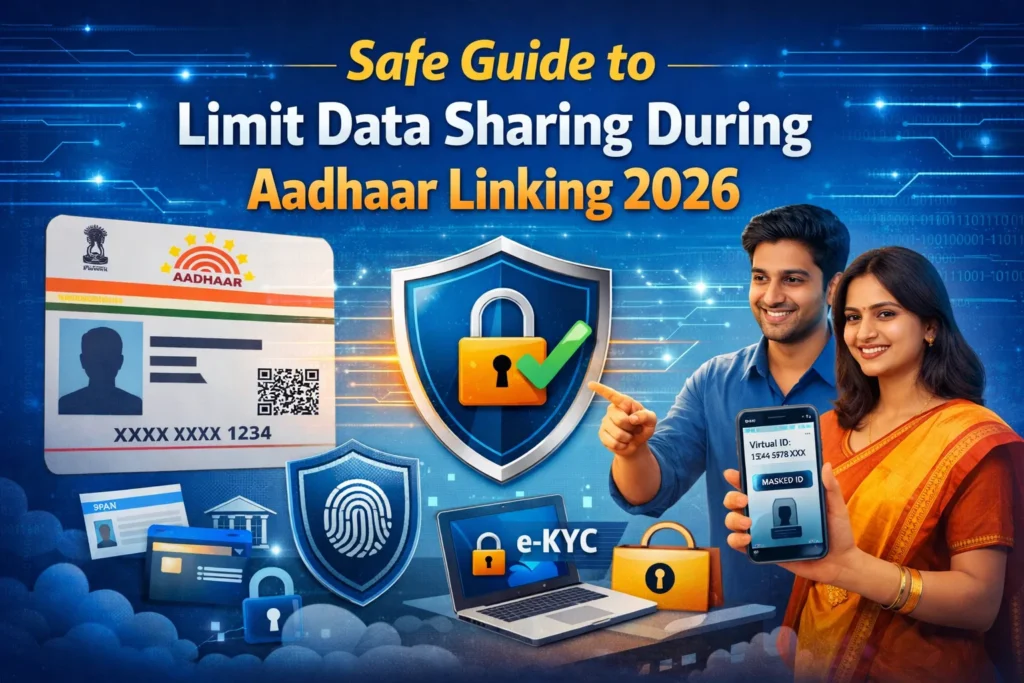
If Aadhaar linking is mandatory for a service, some data has to be used for identity matching, and that part cannot usually be avoided. However, there are ways to limit data sharing during Aadhaar linking effectively. Better control can be gained by using Virtual ID instead of the Aadhaar number where accepted, using masked Aadhaar when the full number is not needed, choosing paperless offline eKYC where available, locking biometrics when they are not required, and avoiding casual sharing of Aadhaar copies over chat apps, email, or unsafe forms. According to Aadhaar UIDAI, offline eKYC can prevent revealing the Aadhaar number, avoid using core biometrics, and allow the Aadhaar holder to choose which demographic details and photo are shared.
What data is usually shared during Aadhaar linking
This part is often misunderstood. Aadhaar based verification is not always the same thing. In one case, only identity matching may be done. In another case, eKYC data may be shared. In another case, offline verification may be used with more limited data. UIDAI defines Aadhaar authentication as a process in which the Aadhaar number, along with demographic information such as name, date of birth, and gender, or biometric information, is submitted for verification against UIDAI records.
The Aadhaar Authentication and Offline Verification Regulations also describe eKYC data as full or limited demographic information and or photograph, and state that the Aadhaar number in eKYC may be full or masked depending on the mode used. This means an important truth should be understood. Not every Aadhaar based interaction reveals the same amount of information. That is why the method chosen matters so much.
Can all data sharing be stopped
In most real cases, no.
If PAN has to be linked with Aadhaar, or if a bank needs Aadhaar for a specific approved process, some details have to be checked so that identity can be confirmed. The Income Tax portal states that PAN should be linked with Aadhaar and warns that an unlinked PAN can become inoperative until the required process is completed. In such a case, a zero data path should not be expected.
But a very important difference should be noted. Not being able to stop all sharing does not mean being unable to reduce unnecessary sharing. Privacy control in the Aadhaar system is often about minimization rather than complete refusal.
Best Ways to Limit Data Sharing During Aadhaar Linking
Use Virtual ID where it is accepted
Virtual ID, often called VID, is one of the simplest privacy tools provided by UIDAI. It is issued as an alternative identifier that can be used in place of the Aadhaar number in certain workflows. UIDAI lists VID generation among its core online services, and paperless offline eKYC can also be generated using VID.
This matters because repeated sharing of the full Aadhaar number can be avoided in places where VID is accepted. For many users, this is the easiest privacy improvement. If a service accepts VID, it is usually better to use it instead of typing the full Aadhaar number again.
Use masked Aadhaar when full number disclosure is not needed
Masked Aadhaar is another strong privacy option. UIDAI provides masked Aadhaar as an official format in which only the last digits are visible while the rest of the number is hidden. This is useful when proof of identity is needed but the full Aadhaar number is not required for the task. In such cases, unnecessary exposure of the full number can be reduced. This is especially helpful when someone requests an Aadhaar copy only as supporting identity proof and not as part of a formal linking process.
Choose paperless offline eKYC where available
This is one of the strongest privacy based methods in the Aadhaar ecosystem. UIDAI says that Aadhaar paperless offline eKYC allows the Aadhaar holder to share KYC data directly without UIDAI being involved in that specific sharing transaction. UIDAI also says the Aadhaar number is not revealed, only a reference ID is shared, no core biometrics are involved, and the holder can choose which demographic data and photo are shared.
The offline file can include selected demographic fields, photo, hashed mobile number, hashed email, and a reference ID. A major privacy benefit is created here. More control is given to the user, and less direct exposure of the Aadhaar number is required.
Lock your biometrics when they are not needed
Biometric use is often the biggest worry for users. UIDAI provides biometric lock and unlock so that fingerprint, iris, and face based Aadhaar authentication can be blocked until the user decides to unlock them. When biometrics are locked, biometric authentication cannot be completed.
This can reduce the chance of misuse when biometric verification is not currently needed. For people who rarely use biometric Aadhaar authentication, a useful safety layer can be created by this feature.
Lock Aadhaar if misuse is suspected
UIDAI also provides Aadhaar lock and unlock controls. UIDAI says authentication using UID, UID token, and VID is blocked while Aadhaar remains locked. If a user feels that details have been overshared or misused, this feature can be used as a stronger protective step. This may not be used every day, but it can be very important during a security concern.
Avoid casual photocopies, screenshots, and chat sharing
A large part of privacy loss does not begin inside official systems. It often begins when full Aadhaar copies are sent over chat apps, email, or unknown websites. UIDAI has created safer methods for a reason. QR based verification, masked Aadhaar, VID, and offline eKYC all support the idea that only limited necessary data should be shown whenever possible. UIDAI also explains that its secure QR code can carry limited identity fields and masked contact details in supported formats.
A very useful habit can be formed here. Before any copy is sent, one question should be asked. Is the full Aadhaar number really needed for this task
Linking and storage are not the same thing
This is one of the most confusing parts for many users. When Aadhaar is linked with PAN or a bank account, it is often imagined that UIDAI now holds a master list of every linked service. UIDAI says that is not how it works. UIDAI states that it does not have visibility into linking of Aadhaar with bank, income tax, and other services, and that such departments do not share this linking information back with UIDAI.
This does not mean privacy risk disappears. It only means the data control question should be understood correctly. The link is usually maintained at the service side for its purpose, not as a universal mapping view held by UIDAI.
What happens in PAN linking
PAN linking is one of the clearest examples of limited user choice. If tax related services are to work smoothly, Aadhaar linking may be required. The Income Tax portal states that PAN should be linked with Aadhaar and warns of PAN becoming inoperative if linking is not completed. In such cases, user preference alone cannot replace the required process.
Still, privacy care should not be abandoned. Only the official portal should be used. Aadhaar details should not be shared with random agents unless truly necessary. The registered mobile number should be kept secure because OTP based misuse becomes easier when number control is lost. The portal also shows that personal profile details, Aadhaar details, bank account details, and contact details are managed inside the user account, so account access should be protected carefully.
What happens in bank linking
Bank linking creates more anxiety because money is involved. But the same principle applies. Enough information may need to be used for seeding, KYC, or benefit related verification, but that does not mean full Aadhaar exposure is required for every future interaction. When a bank or service supports safer methods, those should be preferred. Unofficial agents and weak document sharing channels should be avoided. UIDAI also provides services such as bank seeding status check, VID generation, biometric lock, and offline eKYC, which reflects a broader privacy by design approach.
A Practical Rule to Limit Data Sharing During Aadhaar Linking
A simple rule can be followed. When Aadhaar linking is mandatory, it should be completed only through the official channel and only with the exact information required by that process. When Aadhaar proof is requested but full linking is not truly required, the least revealing official option should be preferred.
In many cases, that means masked Aadhaar, VID, QR verification, or offline eKYC. UIDAI clearly says that offline eKYC does not reveal the Aadhaar number and allows the holder to choose which demographic details are shared. That is one of the clearest examples of user control available today.
What Most Articles Miss About Limit Data Sharing During Aadhaar Linking
Many articles focus only on whether Aadhaar linking is mandatory. Others focus only on privacy fear. The more useful answer sits in between. The real user question is not just whether linking must happen. The real question is how much control remains after that. Current UIDAI material supports a better answer than many general pages give. Full refusal is not always possible, but strong minimization tools do exist, and the method of sharing can make a major difference in how much data is actually exposed.
FAQs
Final Thoughts
So how can data shared during Aadhaar linking be controlled or limited. It usually cannot be reduced to zero if a bank, PAN system, or another approved service legally requires Aadhaar linking or verification. Some information has to be used so the correct identity can be matched. But unnecessary exposure can often be reduced in a meaningful way. The safest approach is to use the full Aadhaar number only when it is truly required. Virtual ID should be used where accepted.
Masked Aadhaar should be used when the full number is not needed. Paperless offline eKYC should be preferred where available because UIDAI says it does not reveal the Aadhaar number and lets the holder choose which demographic data and photo are shared. Biometrics should be locked when they are not needed. Aadhaar can be locked if misuse is feared. Full Aadhaar copies should not be sent casually over unsafe channels. That is the closest thing to smart privacy control in the current Aadhaar system. Not all sharing can be stopped, but a lot of unnecessary exposure can still be prevented.