Why Some Agencies Reject eAadhaar and Ask Original Aadhaar
eAadhaar is legally valid and should be accepted like the physical copy of Aadhaar. It is a password-protected electronic version issued by Aadhaar UIDAI and digitally signed for authenticity. So when an agency asks only for the “original Aadhaar,” the real problem is usually not legality. In most cases, it comes from outdated office practices, poor staff awareness, or weak understanding of digital verification.
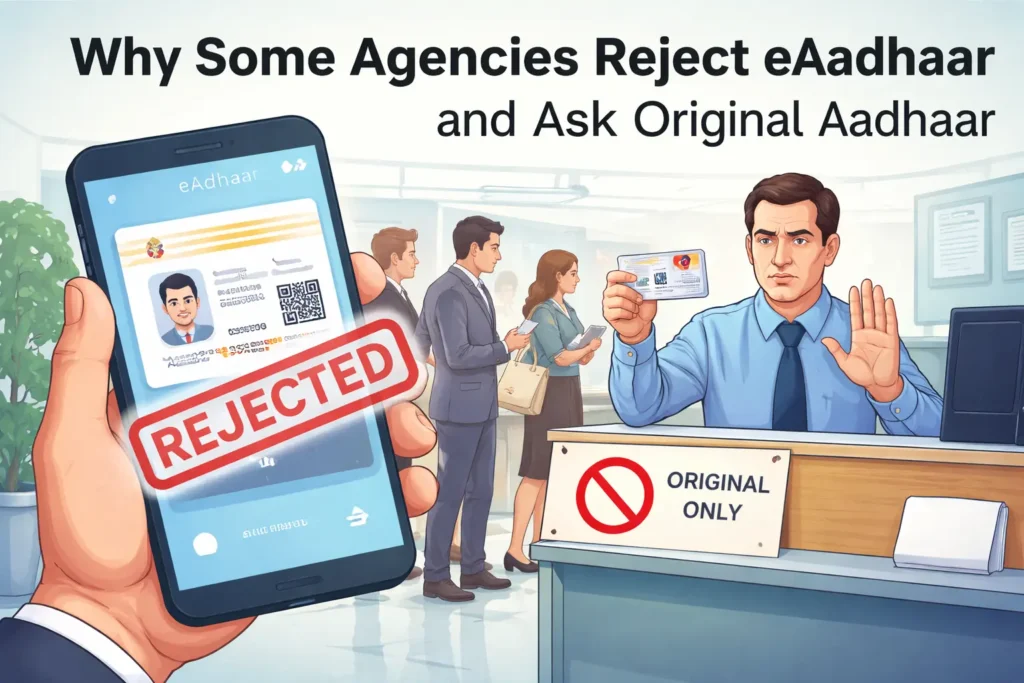
Many citizens still face this issue because agencies reject eAadhaar and insist on a physical copy at banks, telecom offices, hotels, and service counters. Even though the rules are clear, some institutions continue following old document-check routines. This creates confusion and unnecessary inconvenience for Aadhaar holders who are carrying a fully valid digital version.
What Is eAadhaar?
eAadhaar is the downloadable electronic version of Aadhaar. It is generated through the official Aadhaar system and contains the same essential identity details as the printed version. It is not an unofficial scan or a random image file. It is an official digital identity document.
This distinction matters because many people wrongly assume that a paper document is always more authentic than a digital one. In reality, eAadhaar is designed to function as a proper official version of Aadhaar and is recognized within the Aadhaar framework.
Is eAadhaar Legally Valid Like the Physical Aadhaar Copy?
Yes, eAadhaar is legally valid like the physical Aadhaar copy. The Aadhaar framework recognizes Aadhaar in both physical and electronic form. That means a downloaded Aadhaar is not a secondary document or a weaker version. It has the same legal standing for identity purposes.
This is the most important point in the entire discussion. If a service provider rejects eAadhaar only because it is digital, that refusal usually goes against the official position. The issue is not that eAadhaar lacks validity. The issue is that the receiving organization may not be following updated guidance properly.
Why Do Some Agencies Still Ask for the “Original” Aadhaar?
The main reason is lack of awareness. Many front-desk employees and local offices still work with old habits. They may believe that a printed or laminated Aadhaar is safer because that is what they have been asking for over the years.
Another reason is weak training. Some staff members are not properly trained to verify digital Aadhaar through QR codes or official verification methods. Instead of checking whether the document is authentic, they simply ask for paper because it feels familiar.
There is also a compliance mindset problem. Some agencies think collecting a paper copy protects them from risk. In reality, blind preference for paper does not automatically mean stronger verification. Good compliance depends on proper verification, not just physical paperwork.
What the Official Position Really Means
The official position is simple: if an organization accepts a printed Aadhaar, it should also accept downloaded eAadhaar. There should be no unfair distinction between the two forms just because one is digital and the other is physical.
This is where many agencies get it wrong. They confuse visual comfort with legal validity. A paper copy may look more traditional, but a digitally signed eAadhaar is still an official identity document. The law does not reduce its value just because it is shown on a phone or printed later by the user.
Which Aadhaar Formats Can Be Used?
Aadhaar can be used in different official formats. These commonly include the physical Aadhaar letter, eAadhaar, Aadhaar PVC card, and mAadhaar profile. These are all part of the official Aadhaar ecosystem.
This matters because many citizens think only the old paper letter counts as “real Aadhaar.” That idea is outdated. The Aadhaar system has evolved, and digital access is now a major part of how residents use their identity documents in daily life.
Why eAadhaar Can Be More Practical Than a Paper Copy
eAadhaar is often more convenient than carrying a printed document. A person can download it whenever needed, store it securely on a device, and use it quickly during verification. If the original letter is lost, damaged, or unavailable, eAadhaar becomes especially useful.
This practical advantage is one reason digital Aadhaar matters so much. It reduces dependency on paper, speeds up access, and supports modern digital service systems. In many real-life situations, eAadhaar is not just an alternative. It is the most accessible version a user has.
How Aadhaar QR Verification Helps
Aadhaar includes QR-based verification features that allow identity details to be checked securely. This helps agencies confirm that the Aadhaar being presented is genuine and belongs to the correct person.
That is important because proper verification is stronger than simple paper collection. A person can hold a printed card, but if staff are not checking it correctly, the process is still weak. Digital verification tools improve trust and accuracy when used the right way.
Why Some Rejections Still Happen in Practice
In practice, many rejections happen because the person at the counter does not want to take responsibility for a digital document. They may fear making a mistake, so they demand a physical copy to protect themselves from blame. This is a human behavior issue, not a legal issue.
Another practical problem is outdated internal policy. Some offices may still be using old checklists or instructions that were never revised after digital Aadhaar became widely accepted. So the refusal often reflects process delay inside institutions rather than any defect in eAadhaar itself.
What to Do If an agencies reject eAadhaar
First, stay calm and clearly explain that eAadhaar is legally valid. Many problems end at this stage because staff members simply do not know the rule properly.
Second, ask them to verify the Aadhaar instead of rejecting it immediately. If they are using proper verification procedures, the issue may be resolved without further trouble.
Third, ask whether their refusal is based on a written internal rule. This is a smart move because many refusals are based only on informal habits, not actual policy.
Fourth, if the issue still continues, you can file a complaint through official grievance channels. This helps escalate the issue and also pushes institutions to align with proper Aadhaar rules.
A Smarter Privacy Option: Masked Aadhaar
Masked Aadhaar is another useful option for users who do not want to expose their full Aadhaar number unnecessarily. In this version, only the last four digits are visible, while the first eight digits remain hidden.
This can be helpful in low-risk situations where identity confirmation is needed but the full number does not need to be openly shared. It is a useful balance between identity proof and privacy protection.
Why This Issue Matters Beyond One Document
This is not only about Aadhaar. It is also about how institutions respond to digital documents in general. When agencies refuse a valid digital identity document and insist on paper without good reason, it slows down service, increases citizen frustration, and weakens the purpose of digital governance.
In simple words, the bigger issue is trust in digital systems. If authorities want a smoother and more modern service structure, they need to train staff properly and stop treating digital documents like second-class proof.
FAQs
Final Thoughts
Some agencies reject eAadhaar because their systems, staff training, or internal habits have not fully adapted to modern digital verification. But that does not change the legal position. eAadhaar is valid and should not be treated as inferior to the printed Aadhaar copy. The smarter approach is not to force citizens to carry paper for every situation.
The smarter approach is to verify identity properly using the available official tools and accept valid Aadhaar formats without unnecessary friction. For users, the best response is to know their rights, present eAadhaar confidently, and escalate the issue if an agency keeps refusing it without proper reason.